About the service
ScreenGap is built for fast composition-only bandgap screening.
ScreenGap provides a lightweight workflow for screening materials data from simple CSV uploads. The current production path is meant for triage: quickly find formulas worth deeper structure-aware analysis, then validate finalists with experiment, literature, DFT, or a phase-specific model.
Starter model
Matbench-backed
The starter model is the deployed screen_matbench_model path.
JARVIS model
60/40 test split
The checked JARVIS max-12 run uses 11,836 training rows and 7,892 test rows for MBJ bandgaps.
Scope
0-12 eV target range
JARVIS rows with electronic bandgaps above 12 eV are deliberately excluded from that model run.
Benchmarks
How the current models stack up
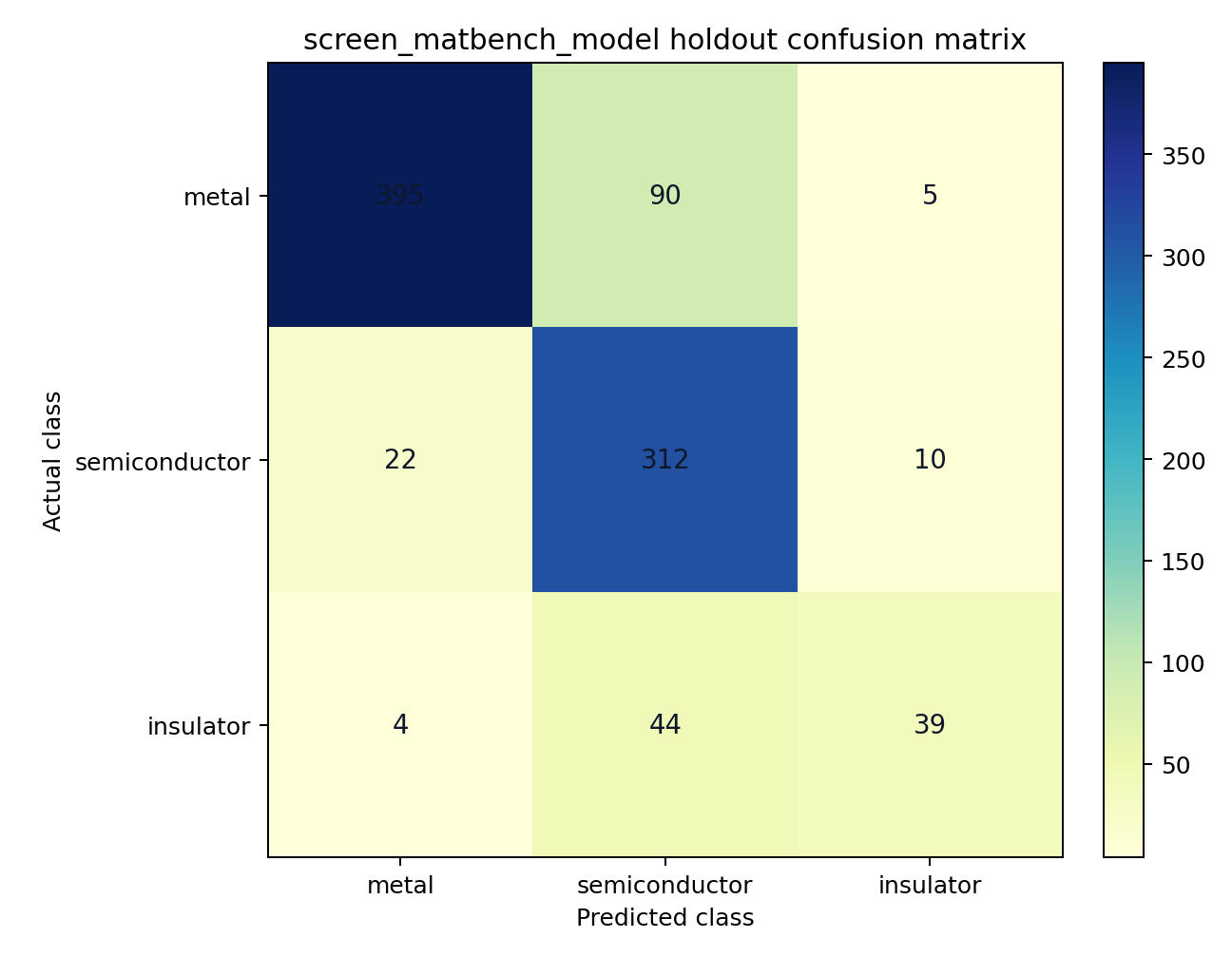
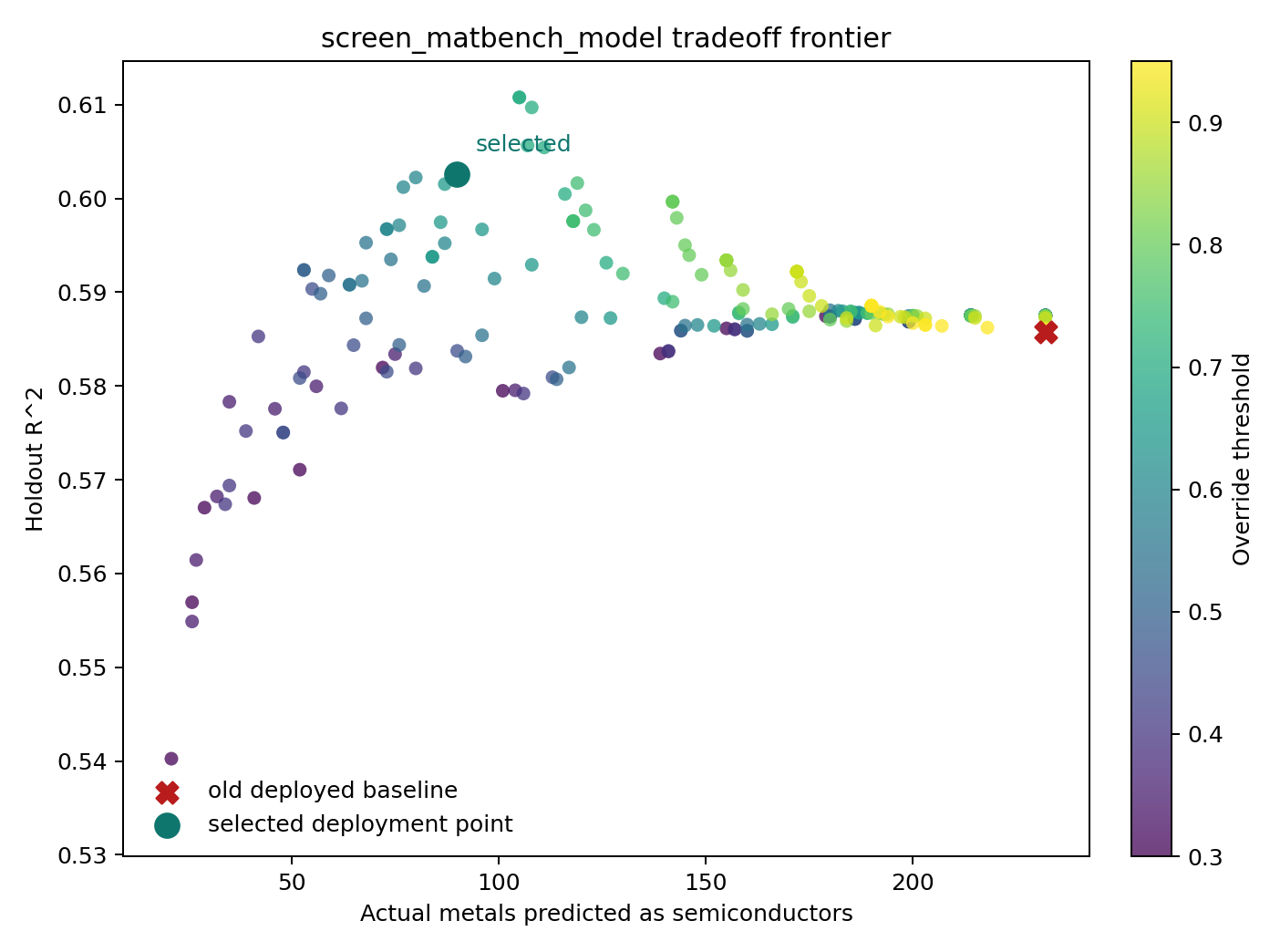
The deployed Matbench starter model is documented with an honest 80/20 holdout. That is the verified split in the current public model artifact. The JARVIS research worker run shown here uses the curated max-12 data files with a 60/40 train/test split.
Matbench R^2
0.603
80/20 holdout
Matbench MAE
0.465 eV
lower is better
JARVIS MBJ R^2
0.758
60/40 holdout
JARVIS MBJ MAE
0.606 eV
max target 12 eV
JARVIS max-12 snapshot
The checked JARVIS curation removes invalid formulas, noble-gas rows, missing MBJ targets, and MBJ electronic bandgaps above 12 eV. For MBJ, 19,728 rows remain after curation: 11,836 train and 7,892 test.
What this means
JARVIS gives ScreenGap a useful second lens because it is not the same data source as Matbench. The max-12 filter keeps the model focused on the electronic bandgap range most relevant to practical screening and avoids letting rare extreme-gap records dominate the fit.
Interpretability
ScreenGap is composition-only. The model does not require crystal structures, and its reporting is organized around formula-derived signals such as element mix, elemental-property aggregates, stoichiometry patterns, and composition interactions. Future reports can expose per-formula feature contributions so users can see which composition signals pushed a prediction higher or lower.
Polymorphs
Different structures can share the same formula and still have different bandgaps. ScreenGap does not choose a specific polymorph or phase from composition alone. Its result should be read as a composition-level screening estimate learned from the training distribution, not as a phase-resolved bandgap guarantee. When polymorphs are central to a decision, users should follow up with structure-aware methods or phase-specific calculations.
Data Use
Uploaded formula lists are processed for requested jobs and service operations. They are not used to train shared models without written permission. Contact support before submitting regulated, export-controlled, or highly confidential data.
Contact
For support, reply to the email you received during signup.
Status
This is an MVP. Expect improvements to model quality, speed, and reporting over time.